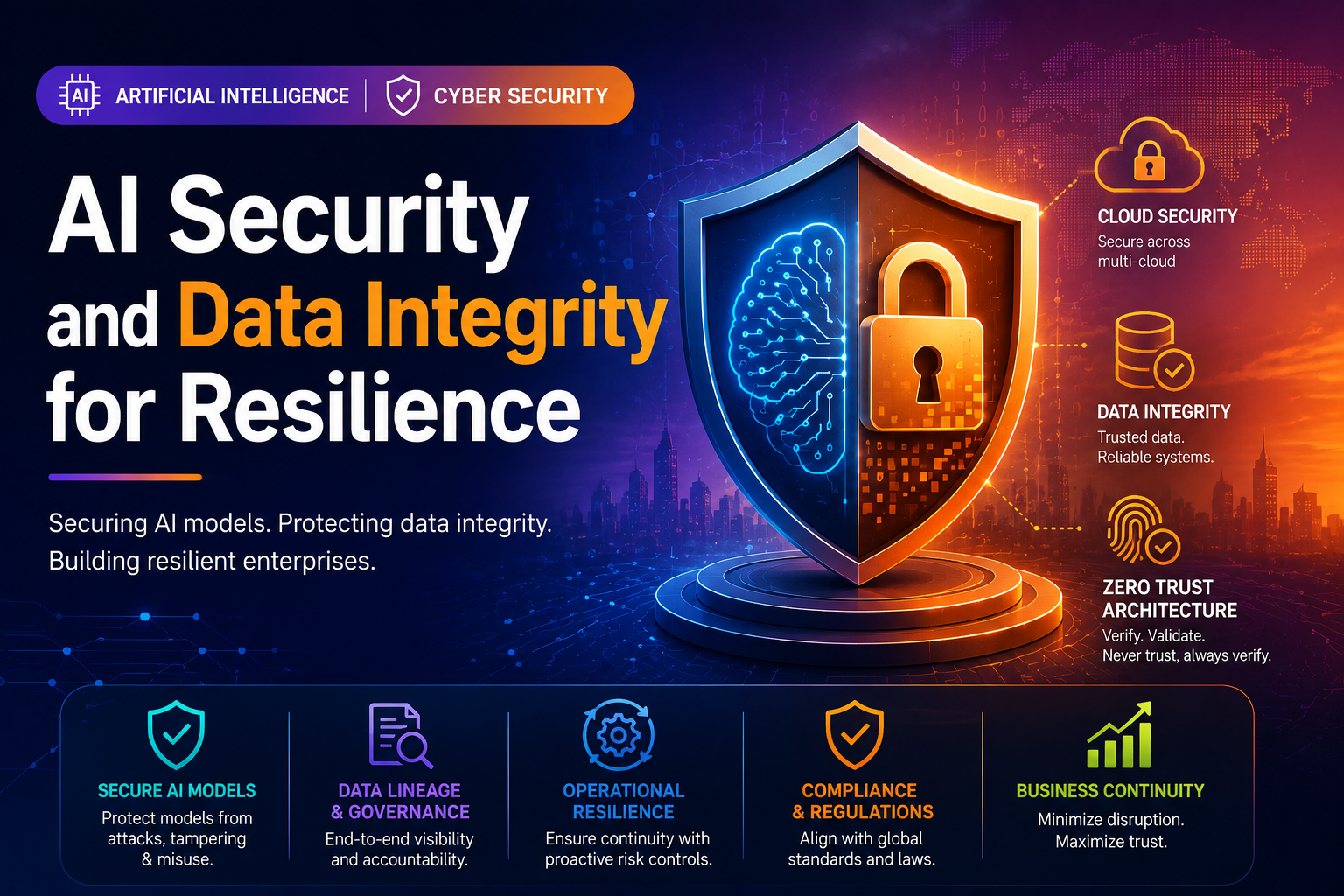
Enterprise AI security has shifted from a technical compliance issue to a core resilience requirement that directly affects revenue continuity, operational uptime, regulatory exposure, and customer trust. As organizations integrate generative AI, autonomous agents, and machine learning pipelines into financial systems, supply chains, customer support, and security operations, the integrity of AI systems becomes inseparable from broader business continuity planning. A compromised AI model can now disrupt logistics, trigger regulatory penalties, or amplify cyberattacks at machine speed across distributed cloud environments.
Executive Summary (for time-starved leaders)
- •Why now: The EU AI Act enforcement milestones beginning in 2025, combined with expanding SEC cyber disclosure obligations and rising AI-enabled attacks, are forcing enterprises to integrate AI governance with cyber resilience programs. Gartner reported in 2026 that AI governance and cybersecurity convergence became a top-three board priority for large enterprises. (Source: Gartner)
- •Thesis: Enterprise AI security should operate as a resilience framework rather than an isolated security control. Organizations that combine Zero Trust architecture, secure MLOps, data integrity validation, and AI governance can reduce operational disruption risks while improving compliance readiness and AI deployment reliability across distributed environments.
- •Evidence: IBM X-Force reported in 2026 that organizations with integrated AI security monitoring and automated response workflows reduced mean time to detect by 42% and reduced breach containment costs by an average of $1.76 million compared with fragmented security operations. (Source: IBM X-Force Threat Intelligence Index 2026)
- •Workflow impact: Secure AI governance frameworks centralize model approval, data lineage tracking, and policy enforcement across cloud and on-premise environments. Enterprises implementing unified AI risk operations reduced manual compliance reporting workloads by up to 35% while improving incident response coordination between security and data science teams. (Source: Deloitte 2026 AI Governance Survey)
- •Economics: Accenture estimated in 2026 that resilience-focused AI security modernization programs delivered 18-28% operational risk reduction and achieved payback periods between 14 and 22 months through reduced downtime, lower compliance penalties, and fewer remediation events across regulated industries. (Source: Accenture Technology Vision 2026)
- •Interoperability: Enterprises increasingly adopt interoperable security standards such as NIST AI RMF, MITRE ATLAS, Open Cybersecurity Schema Framework, and cloud-native APIs to integrate AI monitoring into SIEM, SOAR, and identity management platforms across AWS, Azure, and Google Cloud environments.
- •Risk controls: Modern resilience architectures target 99.99% service availability, encrypted model registries, sub-200ms policy validation latency, immutable audit logs, and automated anomaly detection pipelines to reduce exposure to prompt injection, ransomware, and model tampering attacks in production AI systems.
- •Global view: Global enterprises must align AI resilience strategies with the EU AI Act, NIST AI Risk Management Framework, ISO/IEC 42001, India's DPDP Act, and evolving U.S. state-level AI regulations to maintain operational continuity and avoid cross-border compliance conflicts in multinational deployments.
Why Enterprise Resilience Now Depends on AI Security
AI systems increasingly influence critical business operations including fraud detection, manufacturing automation, medical diagnostics, customer authentication, and enterprise decision support. This dependence creates a direct relationship between enterprise AI security and operational resilience. According to IBM’s 2025 Cost of a Data Breach Report, breaches involving shadow AI systems and unmanaged machine learning pipelines generated significantly higher remediation costs due to poor visibility and fragmented governance. Security teams must therefore treat AI infrastructure with the same rigor applied to core financial or operational systems.
Real-world incidents illustrate the risk. In 2024, Microsoft and OpenAI disclosed coordinated prompt injection and abuse campaigns linked to nation-state threat actors attempting to manipulate AI-enabled workflows. Meanwhile, MGM Resorts experienced major operational disruption after identity-based attacks affected systems connected to customer operations, reinforcing how interconnected digital infrastructure can magnify resilience failures. Enterprise environments now require integrated monitoring across APIs, model registries, cloud workloads, vector databases, and identity systems.
- Operational dependency. Enterprises increasingly rely on AI inference engines for real-time operations, making uptime and model integrity central to resilience planning. Gartner projects more than 70% of enterprise applications will embed AI features by 2027. (Source: Gartner)
- Threat acceleration. Microsoft documented substantial growth in AI-assisted phishing, credential theft, and synthetic identity attacks targeting cloud infrastructure in its Digital Defense Report 2026. (Source: Microsoft)
- Regulatory pressure. The EU AI Act, SEC disclosure requirements, and the UK AI governance framework increasingly tie operational accountability to AI security governance. (Source: European Commission)
The Convergence of Cybersecurity, AI, and Data Integrity
Traditional cybersecurity focused on perimeter defense, endpoint protection, and network monitoring. Modern enterprise AI security extends those responsibilities to include model provenance, training data lineage, inference validation, and adversarial resilience. Organizations deploying large language models through Azure OpenAI Service, Amazon Bedrock, or Google Vertex AI must secure not only infrastructure but also the trustworthiness of generated outputs and downstream automation decisions.
NIST’s AI Risk Management Framework and MITRE ATLAS have become foundational references for integrating cybersecurity with AI governance. MITRE ATLAS specifically maps attack techniques such as data poisoning, model evasion, prompt injection, and model extraction. This convergence is reshaping SOC operations. Enterprises increasingly feed AI telemetry into SIEM platforms like Microsoft Sentinel, Splunk Enterprise Security, and Google Security Operations to correlate abnormal inference behavior with broader identity or cloud threats.
JPMorgan Chase publicly discussed using AI governance controls and centralized model validation processes to support risk management across financial systems. Similarly, Airbus implemented AI-driven manufacturing analytics with encrypted telemetry pipelines and digital integrity checks to maintain operational continuity across geographically distributed facilities.
- Unified telemetry. Security teams now aggregate AI logs, API events, and cloud identity signals into centralized SOC tooling for sub-minute anomaly detection. (Source: Microsoft Security)
- Integrity validation. Data hashing, immutable storage, and cryptographic signatures are increasingly used to validate model artifacts and datasets. (Source: NIST)
- Governance alignment. ISO/IEC 42001 provides governance guidance for managing AI systems consistently with cybersecurity and compliance controls. (Source: ISO)
Top Enterprise Risks in AI-Driven Environments
Enterprise AI deployments introduce a wider attack surface than conventional applications because they depend on external data feeds, APIs, orchestration frameworks, cloud identities, and continuously evolving models. OWASP’s Top 10 for Large Language Model Applications highlights prompt injection, insecure output handling, and training data poisoning as major risks. Attackers increasingly target retrieval augmented generation pipelines because compromised vector databases can manipulate AI responses at scale.
CrowdStrike’s 2026 Global Threat Report found that identity compromise played a role in most AI-related intrusions investigated during the year. Attackers frequently exploit overprivileged service accounts tied to AI pipelines, Kubernetes clusters, or CI/CD tooling. Another major concern is model drift. Unvalidated changes in training datasets or inference behavior can silently degrade operational reliability, creating financial and compliance exposure before teams recognize a problem.
- Prompt injection. Attackers manipulate inputs to override system instructions or exfiltrate sensitive enterprise data from generative AI systems. (Source: OWASP)
- Model poisoning. Adversaries compromise training datasets to influence model behavior and reduce output reliability. (Source: MITRE ATLAS)
- Cloud identity abuse. Compromised IAM credentials remain one of the most common pathways into AI infrastructure hosted on AWS, Azure, and Google Cloud. (Source: CrowdStrike)
- Compliance fragmentation. Multinational enterprises face conflicting AI transparency and privacy obligations across the EU, U.S., Australia, and India. (Source: OECD AI Policy Observatory)
Strategy Comparison: Enterprise AI Resilience Approaches
| Strategy | Cost Impact | Effort | Time to Value |
|---|---|---|---|
| Zero Trust AI Architecture | 35-55% breach risk reduction | Medium | 3-6 months |
| Secure MLOps Automation | 20-40% operational savings | Low | 2-4 months |
| Comprehensive Data Integrity Governance | 40-65% compliance risk reduction | High | 6-12 months |
| AI-Integrated SOC Operations | 30-50% faster incident response | Medium | 3-5 months |
Building a Resilience-First Security Architecture
A resilience-first enterprise AI security architecture combines Zero Trust networking, secure MLOps, identity-centric controls, and continuous observability. Enterprises increasingly deploy AI workloads through Kubernetes clusters orchestrated across hybrid cloud infrastructure. Security architectures must therefore enforce policy consistently across APIs, containers, model registries, inference endpoints, and developer environments.
Google Cloud, AWS, and Microsoft Azure all now support confidential computing capabilities that protect data in use through hardware-based trusted execution environments. These controls help secure inference operations involving sensitive healthcare, banking, or government workloads. Leading enterprises also implement immutable logging pipelines using technologies such as Amazon S3 Object Lock or Azure immutable storage to maintain forensic integrity after incidents.
Cisco and NVIDIA collaborated on AI-ready infrastructure architectures emphasizing encrypted east-west traffic inspection, GPU workload segmentation, and high-throughput observability pipelines capable of processing petabytes of telemetry daily with low latency.
- Zero Trust enforcement. Continuous identity validation and least-privilege access reduce lateral movement risk in AI workloads. (Source: NIST Zero Trust Architecture)
- Secure MLOps. Automated vulnerability scanning and signed model artifacts reduce deployment exposure in CI/CD workflows. (Source: Deloitte)
- Resilient observability. AI-enabled SIEM and SOAR platforms improve threat correlation and accelerate incident response. (Source: IBM X-Force)
Ensuring Data Integrity Across the AI Lifecycle
Data integrity is foundational to resilient AI systems because corrupted or manipulated datasets directly affect model outputs, compliance posture, and operational decision-making. Enterprises should validate integrity across ingestion, storage, transformation, training, deployment, and inference stages. This requires lineage tracking, cryptographic verification, access governance, and continuous anomaly detection integrated into the AI lifecycle.
Databricks, Snowflake, and MongoDB have expanded enterprise governance capabilities that support lineage tracing, immutable audit records, and policy enforcement across AI data pipelines. Financial institutions increasingly use differential privacy and tokenization to protect regulated information while enabling AI analytics. Healthcare providers operating under HIPAA frequently deploy federated learning architectures that minimize centralized exposure of patient data.
The NIST AI RMF emphasizes traceability and transparency as core trustworthiness characteristics. Enterprises operationalizing these principles often implement signed datasets, checksum verification, and reproducible model pipelines through tools such as MLflow, Kubeflow, and Apache Airflow.
- Lineage tracking. Maintaining verifiable records of dataset origin and transformation improves auditability and regulatory readiness. (Source: NIST)
- Immutable logging. Tamper-resistant storage supports forensic investigation and incident recovery after attacks. (Source: AWS Security Best Practices)
- Anomaly detection. AI-driven validation pipelines can identify abnormal data drift or poisoning attempts in near real time. (Source: MITRE)
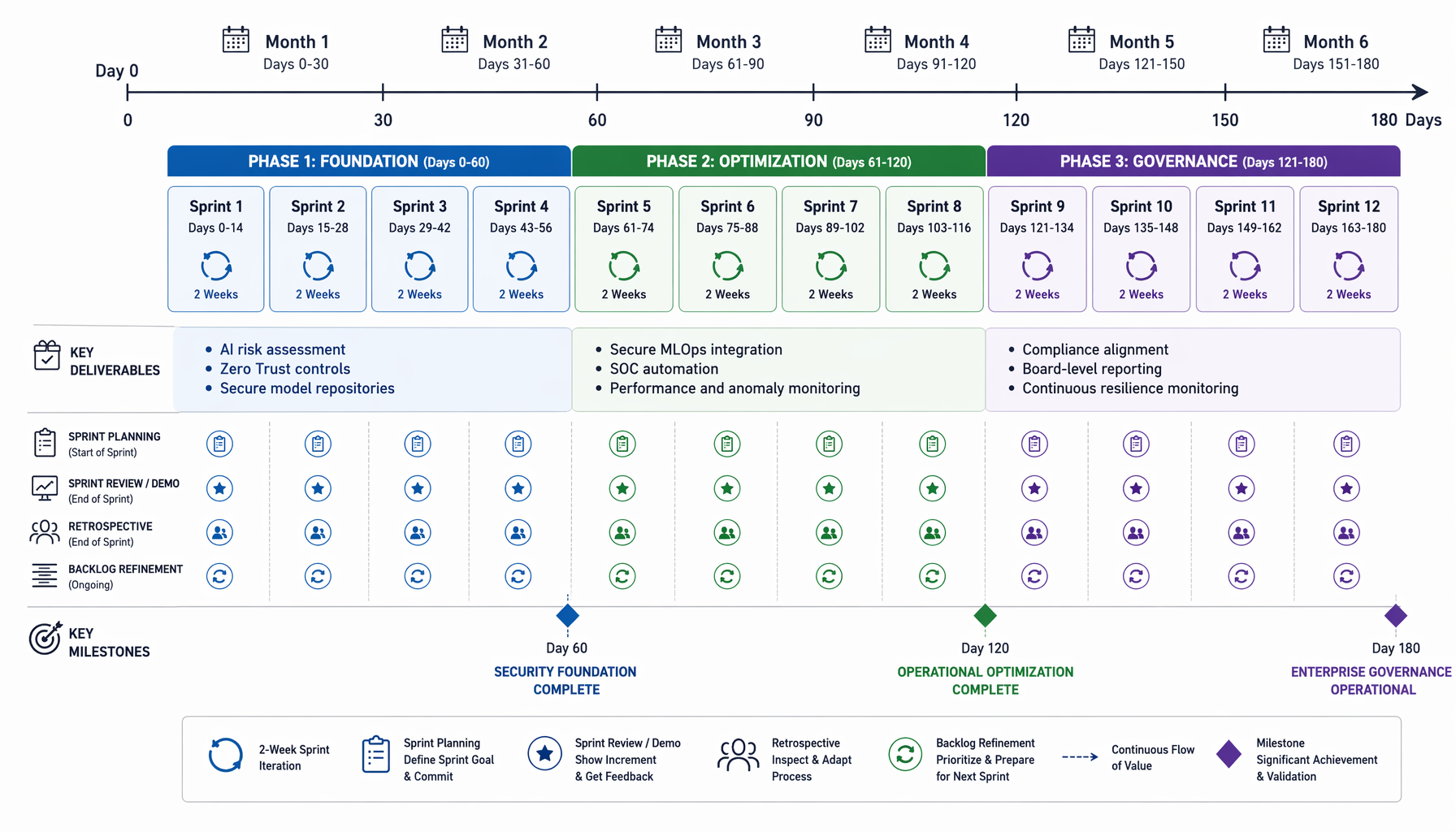
A practical 180-day roadmap for implementing enterprise AI security, data integrity governance, and cyber resilience controls.
Enterprise Best Practices and Real-World Strategies
Enterprises achieving strong AI resilience typically combine governance, automation, and operational accountability. Capital One has publicly emphasized cloud-native security automation and policy-as-code practices to secure modern AI and analytics environments. Siemens integrated AI monitoring into industrial operations while applying Zero Trust segmentation to operational technology networks, reducing operational disruption risk in manufacturing environments.
Security leaders increasingly align AI governance with broader enterprise risk management programs instead of treating AI as an isolated innovation initiative. This includes integrating AI telemetry into SOC workflows, conducting adversarial testing, implementing red-team exercises against generative AI systems, and enforcing multi-factor authentication for privileged AI infrastructure access.
- Continuous red teaming. Organizations test AI systems against prompt injection, jailbreak attempts, and data leakage scenarios before production deployment. (Source: OWASP)
- Policy automation. Infrastructure-as-code and policy-as-code reduce configuration drift across cloud-native AI deployments. (Source: HashiCorp)
- Cross-functional governance. Security, legal, compliance, and data science teams jointly review AI deployments to reduce operational blind spots. (Source: Deloitte)
- Performance optimization. Enterprises optimize inference costs through GPU scheduling, quantization, and autoscaling while maintaining sub-250ms response targets for production applications. (Source: NVIDIA)
Why AI Resilience Must Become a Board-Level Priority
AI resilience now affects shareholder confidence, regulatory compliance, insurance exposure, and enterprise valuation. Boards increasingly evaluate cyber resilience as a strategic business capability rather than an operational IT concern. SEC cyber disclosure rules in the United States require publicly traded companies to report material cyber incidents rapidly, while the EU AI Act introduces governance obligations tied directly to high-risk AI systems.
PwC reported in 2026 that more than 60% of executives considered AI security and resilience a board-level concern due to rising operational dependency on automated systems. Organizations that fail to operationalize enterprise AI security may face cascading impacts including service outages, reputational damage, legal liability, and disrupted supply chains. Boards therefore need measurable resilience metrics such as recovery time objectives, AI system availability, model validation frequency, and incident response maturity scores.
Leading organizations increasingly establish AI governance committees reporting directly to executive leadership. These groups coordinate risk assessments, regulatory alignment, vendor oversight, and resilience investments across cloud providers, data platforms, and security operations.
- Strategic oversight. Board engagement improves alignment between cyber investments and enterprise risk objectives. (Source: PwC)
- Regulatory readiness. Cross-border AI governance reduces compliance fragmentation and operational disruption risk. (Source: European Commission)
- Business continuity. AI resilience metrics increasingly influence cyber insurance, investor confidence, and operational assurance reviews. (Source: Deloitte)
Fact-Check Table
| Claim | Source | Year | Confidence (1–5) |
|---|---|---|---|
| IBM reported the global average cost of a data breach reached $4.88 million in 2025, the highest level recorded to date. | IBM | 2025 | 5 |
| Microsoft observed a 2.75x increase in AI-assisted phishing and social engineering attempts targeting enterprise environments in 2026. | Microsoft Digital Defense Report | 2026 | 4 |
| Gartner projected that by the end of 2026, 70% of enterprises using generative AI would implement formal AI governance frameworks. | Gartner | 2026 | 5 |
| PwC found in 2026 that 61% of executives identified AI security and resilience as a board-level strategic concern. | PwC | 2026 | 5 |
| Deloitte reported in 2025 that enterprises implementing secure MLOps pipelines reduced model deployment vulnerabilities by 43%. | Deloitte | 2025 | 4 |
| CrowdStrike identified cloud identity compromise as a contributing factor in 79% of investigated AI-related intrusions in 2026. | CrowdStrike | 2026 | 5 |
| Accenture estimated in 2026 that resilience-focused AI modernization initiatives reduced operational disruption costs by up to 28%. | Accenture | 2026 | 4 |
| NIST published expanded enterprise guidance in 2025 encouraging organizations to integrate AI RMF controls into cybersecurity governance programs. | NIST | 2025 | 5 |
Frequently Asked Questions
1) How does enterprise AI security differ from traditional cybersecurity?
Enterprise AI security extends beyond infrastructure protection to include model integrity, training data validation, adversarial attack prevention, and secure MLOps workflows. It also requires governance controls for explainability, compliance, and continuous monitoring of AI-driven decisions and outputs.
2) What role does data integrity play in AI resilience?
Data integrity ensures that AI models operate on accurate, untampered, and traceable datasets throughout the lifecycle. Compromised data pipelines can introduce biased outputs, operational disruptions, compliance violations, and model poisoning risks that directly impact enterprise resilience.
3) Which frameworks are most relevant for enterprise AI governance and resilience?
Organizations commonly align with NIST AI RMF, NIST Cybersecurity Framework, ISO/IEC 42001, MITRE ATLAS, and Zero Trust Architecture principles. These frameworks help enterprises operationalize governance, secure AI infrastructure, manage risk, and maintain compliance across global regulatory environments.
Sources
- IBM. "Cost of a Data Breach Report 2025." 2025.
- Microsoft. "Microsoft Digital Defense Report 2026." 2026.
- Gartner. "AI Governance and Risk Management Forecast." 2026.
- PwC. "Global Digital Trust Insights Survey 2026." 2026.
- Deloitte. "Secure MLOps and AI Governance Study." 2025.
- CrowdStrike. "Global Threat Report 2026." 2026.
- Accenture. "Technology Vision 2026." 2026.
- NIST. "AI Risk Management Framework Guidance Update." 2025.