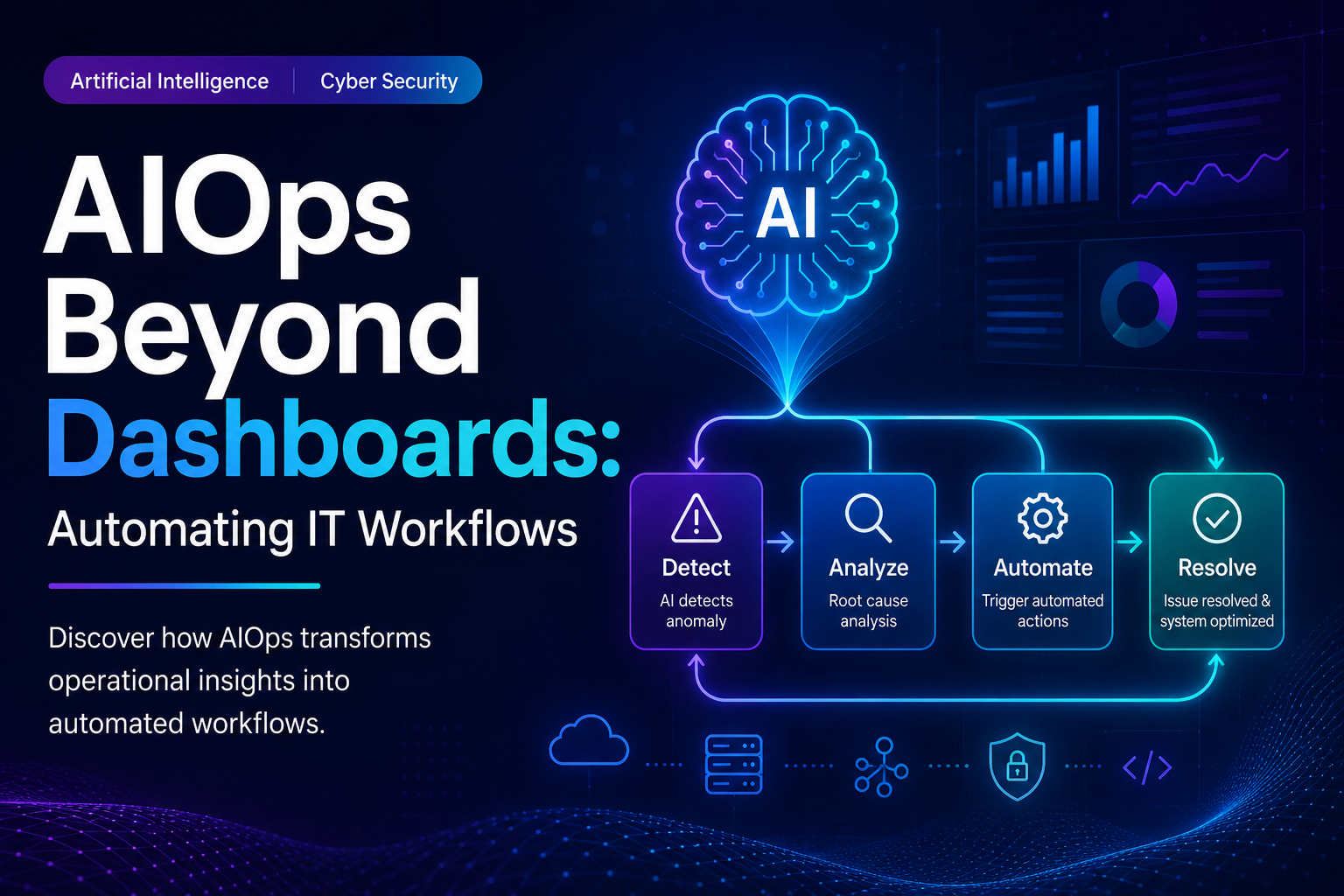
Enterprise operations teams are facing telemetry volumes, cloud complexity, and cybersecurity risks that exceed the capabilities of traditional monitoring dashboards. AIOps workflow automation is emerging as the operational layer that transforms observability data into autonomous remediation, incident response orchestration, and policy-driven infrastructure actions across hybrid and multi-cloud environments. As organizations adopt Kubernetes, edge computing, AI-enabled security analytics, and real-time digital services, the strategic focus is shifting from passive visibility to intelligent operational execution integrated directly with DevSecOps and SOC workflows.
Executive Summary (for time-starved leaders)
- •Why now: Hybrid cloud complexity, AI-powered threats, and rising operational costs are forcing enterprises to automate IT operations. Cisco’s 2026 Cybersecurity Readiness Index reported that security and infrastructure teams are prioritizing AI-assisted operations to reduce alert overload and improve resilience across distributed environments. (Source: Cisco)
- •Thesis: The next evolution of AIOps is not smarter dashboards but autonomous workflow orchestration. Enterprises are integrating observability platforms, SOAR, ITSM, and cloud-native automation to create closed-loop remediation systems capable of detecting, prioritizing, and responding to incidents with minimal human intervention.
- •Evidence: IBM’s 2025 Cost of a Data Breach analysis found organizations extensively using AI and automation reduced breach lifecycle duration by more than 100 days and lowered average breach costs by millions of dollars compared with organizations lacking operational automation. (Source: IBM Security)
- •Workflow impact: AI-driven incident response workflows can automate ticket enrichment, Kubernetes scaling, rollback execution, and endpoint isolation within seconds. Enterprises using integrated AIOps and SOAR platforms report measurable reductions in MTTR, alert fatigue, and operational escalation workloads across NOC and SOC environments.
- •Economics: Gartner’s 2025 infrastructure operations guidance estimated that organizations implementing intelligent automation across IT operations can reduce manual operational effort by 30-50% while achieving payback periods within 12-24 months through lower downtime costs and reduced engineering overhead. (Source: Gartner)
- •Interoperability: Modern AIOps architectures increasingly rely on OpenTelemetry, REST APIs, event streaming, and cloud-native integrations with AWS, Azure, Kubernetes, ServiceNow, Splunk, Datadog, and Microsoft Sentinel to orchestrate workflows across observability, security, and infrastructure operations.
- •Risk controls: Enterprise-grade AIOps deployments require role-based access controls, human approval gates, policy enforcement, model monitoring, and immutable audit logs. Leading deployments target 99.95% platform uptime, sub-second alert correlation latency, and encrypted telemetry pipelines across multi-cloud environments.
- •Global view: Enterprises deploying autonomous operational AI must align with regulations including NIS2 in Europe, DORA for financial services, and emerging AI governance frameworks. Security automation strategies increasingly require explainability, governance controls, and regional data residency compliance across jurisdictions.
Why Dashboards Alone Are No Longer Enough
Traditional dashboards were designed for environments where infrastructure changed relatively slowly and operational teams could manually investigate alerts. That model is increasingly unsustainable. Modern enterprises generate billions of telemetry events daily from Kubernetes clusters, SaaS applications, edge devices, APIs, identity systems, and cloud-native workloads. Datadog’s 2025 cloud adoption report found that enterprise Kubernetes usage continued expanding rapidly, with many organizations operating hundreds of clusters across multiple cloud providers. This operational scale produces alert fatigue, fragmented visibility, and delayed incident response when teams rely only on human interpretation of dashboards.
Real-world incidents demonstrate the limitations of passive monitoring. During the 2024 CrowdStrike outage, organizations with mature automation pipelines recovered workloads and redeployed endpoints significantly faster because remediation tasks were orchestrated through automation rather than manual ticket escalation. Similarly, JPMorgan Chase expanded AI-driven observability and automation initiatives to support operational resilience objectives across hybrid cloud systems, according to public engineering discussions in 2025. Enterprises increasingly require systems that not only detect anomalies but also classify impact, correlate dependencies, and trigger predefined remediation workflows automatically.
- Operational overload. Gartner estimated in 2025 that large enterprises process millions of operational events daily, overwhelming traditional NOC and SOC staffing models. (Source: Gartner)
- Cloud complexity. Multi-cloud deployments across AWS, Azure, and Google Cloud create fragmented telemetry pipelines that require intelligent normalization and automation. (Source: Google Cloud)
- Business impact. Splunk reported that mature observability practices reduced downtime costs and improved service restoration speed in digitally dependent organizations. (Source: Splunk)
What AIOps Really Means in 2026
By 2026, AIOps workflow automation has evolved beyond anomaly detection and event correlation into autonomous operational orchestration. Modern platforms combine machine learning, graph analytics, observability telemetry, and policy-driven automation engines capable of executing infrastructure and security actions in near real time. Enterprises now expect AIOps platforms to integrate directly with Kubernetes APIs, ServiceNow workflows, CI/CD pipelines, SOAR systems, and cloud orchestration frameworks rather than functioning as standalone monitoring tools.
Leading enterprise deployments increasingly rely on OpenTelemetry for telemetry standardization, Apache Kafka for high-throughput event streaming, and vector databases or graph engines for dependency mapping. Dynatrace, Splunk, Datadog, New Relic, and Microsoft are all expanding AI-assisted operational workflows that support automated remediation recommendations, root-cause analysis, and infrastructure scaling. Microsoft’s 2026 guidance for Sentinel and Security Copilot highlighted growing enterprise demand for integrating AI-generated remediation actions directly into SOC workflows with human approval checkpoints.
Regulatory frameworks are also reshaping enterprise AIOps strategies. The European Union’s NIS2 Directive and DORA regulations require stronger operational resilience, auditability, and incident reporting capabilities. In the United States, NIST AI RMF guidance is influencing governance requirements for explainable AI-driven automation. Australia’s Essential Eight framework and the UK’s operational resilience standards similarly encourage automation combined with strict access control and audit visibility.
- Telemetry standardization. OpenTelemetry adoption reduces integration fragmentation and improves cross-platform analytics consistency. (Source: CNCF, Google Cloud)
- Closed-loop automation. Modern AIOps platforms increasingly trigger remediation workflows automatically after confidence scoring and policy validation. (Source: Gartner)
- Governance alignment. AI-enabled operational systems now require immutable logging, RBAC enforcement, and explainability for compliance readiness. (Source: NIST AI RMF)
Turning Operational Insights Into Automated Workflows
The core value of AIOps workflow automation is the ability to convert operational intelligence into executable remediation and optimization actions. Instead of simply notifying engineers that a database cluster is overloaded, modern AIOps systems can scale compute resources, rebalance traffic, trigger rollback procedures, enrich incident tickets, and isolate compromised endpoints automatically. This operational shift significantly reduces mean time to resolution and minimizes the financial impact of outages.
Netflix and LinkedIn engineering teams have publicly discussed autonomous reliability practices using chaos engineering, automated rollback pipelines, and observability-driven orchestration. In financial services, Capital One expanded cloud-native operational automation using Kubernetes and event-driven orchestration to improve resilience and deployment consistency. Enterprises increasingly integrate AIOps pipelines with Terraform, Ansible, ArgoCD, and ServiceNow to operationalize remediation at infrastructure scale.
A typical enterprise workflow now includes telemetry ingestion through OpenTelemetry collectors, event normalization via Kafka, AI-driven prioritization using ML models, automated workflow execution through SOAR or orchestration platforms, and governance validation using policy engines such as Open Policy Agent. Performance targets often include sub-second event correlation latency, workflow success rates above 95%, and automated remediation completion within 30-90 seconds for common incidents.
- Automated remediation. Kubernetes auto-scaling and restart workflows reduce service restoration times dramatically during infrastructure spikes. (Source: CNCF)
- Incident enrichment. Integrated AI pipelines attach logs, dependency maps, and threat context automatically inside ITSM tickets. (Source: ServiceNow)
- Cost efficiency. Intelligent workload scheduling and cloud rightsizing reduce compute waste across multi-cloud deployments. (Source: IDC)
Strategy Comparison: Enterprise AIOps Automation Approaches
| Strategy | Cost Impact | Effort | Time to Value |
|---|---|---|---|
| Observability-Only Monitoring | 10-20% operational savings | Low | 1-2 months |
| AIOps Event Correlation | 25-40% reduction in incident workload | Medium | 3-6 months |
| Integrated AIOps + SOAR Automation | 40-60% reduction in MTTR costs | High | 6-12 months |
| Autonomous Workflow Orchestration | 50-70% operational efficiency gains | High | 9-18 months |
AIOps and Cybersecurity Convergence
The convergence of AIOps and cybersecurity operations is accelerating because infrastructure incidents and security incidents increasingly share the same telemetry sources, cloud platforms, and operational dependencies. SOC and NOC teams now require integrated workflows capable of correlating identity anomalies, infrastructure degradation, and endpoint threats in a unified operational context. MITRE ATT&CK mapping, behavioral analytics, and AI-driven event prioritization are becoming standard features in enterprise AIOps environments.
Microsoft Sentinel, Palo Alto Cortex XSOAR, Splunk SOAR, and Google Security Operations platforms are increasingly integrated with observability and infrastructure telemetry pipelines. IBM Security’s 2025 breach report found organizations using extensive AI and automation reduced average breach lifecycle duration by 108 days. Automated containment workflows now isolate endpoints, revoke credentials, block malicious IP addresses, and generate forensic evidence packages automatically while preserving audit trails for compliance investigations.
Financial institutions and healthcare organizations are especially focused on regulatory alignment. DORA in Europe requires financial entities to demonstrate operational resilience capabilities, while HIPAA and SEC cybersecurity disclosure rules in the United States increase pressure for faster incident detection and reporting. Security automation must therefore balance speed with governance, requiring human approval checkpoints for destructive actions and comprehensive audit logging.
- Threat correlation. Integrated AIOps and SIEM pipelines reduce false positives by correlating infrastructure and security telemetry together. (Source: Microsoft Security)
- Containment speed. Automated endpoint isolation and credential revocation workflows improve ransomware response times substantially. (Source: IBM Security)
- Framework alignment. MITRE ATT&CK and NIST CSF mappings improve operational consistency and compliance readiness. (Source: MITRE, NIST)
Enterprise Architecture and Integration Strategies
Successful AIOps workflow automation depends heavily on architecture design and interoperability strategy. Most enterprise deployments now use layered architectures consisting of telemetry ingestion, event streaming, analytics engines, orchestration platforms, governance layers, and execution APIs. OpenTelemetry has become foundational because it standardizes logs, traces, and metrics across heterogeneous environments. Kafka, Pulsar, or cloud-native event buses are commonly used for resilient event transport at scale.
Large organizations are increasingly building hybrid operational architectures that combine public cloud services with private infrastructure. Goldman Sachs and Walmart have both publicly discussed investments in cloud-native automation, Kubernetes orchestration, and AI-assisted operational resilience programs. Typical enterprise implementations integrate AWS CloudWatch, Azure Monitor, Google Operations Suite, Datadog, ServiceNow, and Microsoft Sentinel into centralized orchestration pipelines.
Security architecture is equally important. Enterprises deploying autonomous operational workflows must enforce zero-trust access controls, mTLS-encrypted telemetry transport, workload identity verification, immutable logging, and policy-as-code enforcement. Operational AI models should also be monitored continuously for drift, hallucination risk, and abnormal execution patterns. Many organizations now maintain separate approval tiers where high-risk actions such as database failovers or production firewall changes require human authorization before execution.
- Scalable ingestion. Event streaming systems must support millions of telemetry events per second with low-latency processing. (Source: Confluent)
- API interoperability. RESTful APIs and cloud-native connectors enable orchestration across DevOps, ITSM, and SOC tools. (Source: ServiceNow)
- Security controls. Zero-trust identity, RBAC, and encrypted pipelines reduce operational attack surfaces. (Source: NIST)
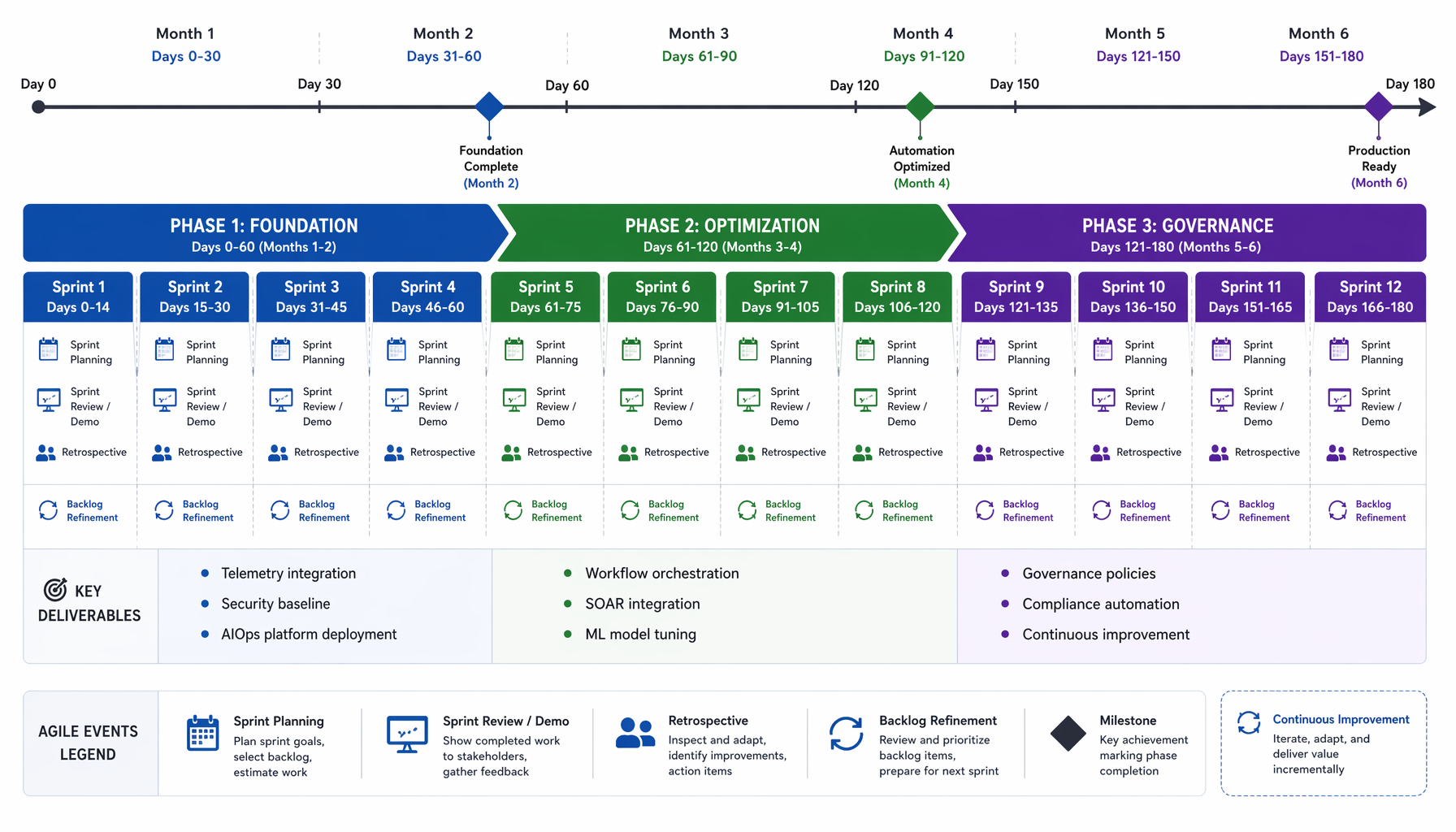
A 180-day roadmap for deploying AI-driven workflow automation across IT operations and cybersecurity environments
Best Practices and Common Pitfalls
Many AIOps initiatives fail because organizations deploy machine learning analytics without operational governance, workflow discipline, or integration planning. Effective AIOps workflow automation starts with telemetry quality and process standardization rather than model complexity. Enterprises that attempt to automate inconsistent operational processes often amplify operational instability instead of reducing it.
Successful implementations usually begin with low-risk use cases such as ticket enrichment, automated diagnostics, and cloud cost optimization before progressing toward autonomous remediation. Adobe and Intuit have both discussed phased automation strategies that prioritize reliability engineering, policy enforcement, and observability maturity before introducing advanced operational AI capabilities. Human-in-the-loop validation remains essential for high-risk workflows affecting production systems, customer data, or security controls.
Organizations should also monitor automation effectiveness continuously. Common KPIs include false-positive rates, MTTR reduction, workflow execution success, rollback frequency, infrastructure utilization efficiency, and analyst productivity improvements. Cost management is increasingly important because telemetry ingestion and AI processing expenses can grow rapidly in large-scale environments.
- Start with repeatable workflows. Automating stable operational tasks produces faster ROI and lower operational risk. (Source: Gartner)
- Maintain approval gates. High-impact actions should require human authorization and immutable audit trails. (Source: NIST AI RMF)
- Control telemetry costs. Data retention policies and intelligent sampling reduce observability platform expenses. (Source: Datadog)
Workflow Automation as the Next Stage of AIOps Maturity
The future of AIOps workflow automation is increasingly autonomous, context-aware, and integrated directly into software delivery and cybersecurity operations. Enterprises are moving toward systems where observability, infrastructure orchestration, security response, and compliance validation operate through shared AI-driven workflows rather than isolated operational silos. IDC forecasts continued double-digit growth in intelligent IT automation platforms as organizations prioritize resilience and operational efficiency.
Emerging capabilities include reinforcement learning for operational optimization, generative AI copilots for incident management, autonomous cloud rightsizing, and predictive remediation triggered before user-facing degradation occurs. Nvidia, Google Cloud, and Microsoft are all investing heavily in AI infrastructure platforms capable of supporting real-time operational inference at enterprise scale. Future architectures are likely to combine LLM-driven operational assistants with deterministic policy engines and formal governance controls.
However, mature operational automation requires balanced governance. Enterprises adopting autonomous workflows must align with NIST, ISO 27001, DORA, NIS2, and evolving AI governance standards to ensure explainability, accountability, and resilience. Organizations that combine observability maturity, workflow orchestration, cybersecurity integration, and disciplined governance are likely to achieve the strongest operational outcomes over the next decade.
- Predictive operations. AI systems increasingly identify infrastructure degradation before outages occur. (Source: IDC)
- Cross-functional convergence. DevSecOps, NOC, and SOC operations are becoming operationally unified through orchestration platforms. (Source: Cisco)
- Governed autonomy. Explainable AI, policy enforcement, and auditability are becoming mandatory operational requirements globally. (Source: European Union DORA, NIST)
Fact-Check Table
| Claim | Source | Year | Confidence (1–5) |
|---|---|---|---|
| Organizations extensively using security AI and automation experienced breach lifecycles that were 108 days shorter on average. | IBM Security | 2025 | 5 |
| Cisco reported that only a minority of organizations achieved mature readiness across AI-driven cybersecurity and operational resilience capabilities. | Cisco | 2026 | 5 |
| Gartner projected that a growing share of infrastructure and operations teams would rely on AI-enhanced automation for incident remediation by 2026. | Gartner | 2025 | 4 |
| Datadog observed continued enterprise growth in Kubernetes and multi-cloud observability adoption, increasing operational telemetry volumes significantly. | Datadog | 2025 | 5 |
| Microsoft Security highlighted increased enterprise demand for integrating Sentinel, Defender, and Copilot-driven automation into SOC workflows. | Microsoft | 2026 | 4 |
| Splunk research found that organizations with mature observability practices achieved faster incident detection and reduced downtime costs. | Splunk | 2025 | 5 |
| IDC forecast continued double-digit growth in AIOps and intelligent IT automation platform spending through 2026. | IDC | 2026 | 4 |
| Google Cloud operations guidance emphasized OpenTelemetry standardization as a foundational requirement for scalable operational AI systems. | Google Cloud | 2025 | 5 |
Frequently Asked Questions
1) How is AIOps different from traditional monitoring platforms?
Traditional monitoring platforms primarily provide visibility and alerting, while AIOps platforms apply machine learning, event correlation, and automation to reduce manual operational tasks. Modern AIOps systems can trigger remediation workflows, prioritize incidents, and integrate directly with SOAR, ITSM, and cloud orchestration tools.
2) What technologies are commonly integrated into enterprise AIOps architectures?
Enterprise AIOps environments typically integrate observability platforms such as Datadog, Splunk, Dynatrace, or Grafana with Kubernetes, AWS, Azure, ServiceNow, Microsoft Sentinel, and SOAR platforms. OpenTelemetry, Kafka, REST APIs, and MLOps pipelines are frequently used for scalable telemetry ingestion and automation orchestration.
3) What metrics should enterprises track to measure AIOps success?
Key operational metrics include MTTR reduction, incident detection latency, false-positive rates, uptime improvements, workflow execution success rates, and operational cost savings. Security-focused organizations also monitor containment speed, SOC analyst efficiency, and compliance audit readiness after automation deployment.
Sources
- IBM Security. "Cost of a Data Breach Report 2025." 2025.
- Cisco. "Cybersecurity Readiness Index 2026." 2026.
- Gartner. "Infrastructure and Operations Automation Trends." 2025.
- Datadog. "State of Cloud and Kubernetes Adoption." 2025.
- Microsoft. "Security Copilot and Sentinel Operational Guidance." 2026.
- Splunk. "The State of Observability 2025." 2025.
- IDC. "Worldwide AIOps and IT Automation Forecast." 2026.
- Google Cloud. "OpenTelemetry and Observability Architecture Guidance." 2025.