Enterprises spent aggressively on generative AI, intelligent automation, and predictive analytics between 2023 and 2026, yet many organizations still struggle to convert AI investment into measurable enterprise value tied directly to revenue growth, cybersecurity resilience, and operational performance. Gartner, IDC, and McKinsey research consistently show that organizations succeeding with AI are not merely deploying models; they are integrating governance, cloud optimization, data engineering, and executive accountability into enterprise-wide transformation programs.
The next phase of enterprise AI maturity focuses on measurable outcomes rather than experimentation. That means aligning AI initiatives with quantifiable KPIs such as reduced security incident response times, improved customer retention, lower infrastructure costs, higher employee productivity, and accelerated product delivery cycles. Organizations that operationalize AI through secure architecture, FinOps visibility, and executive reporting frameworks are increasingly outperforming peers in both profitability and resilience.
Executive Summary (for time-starved leaders)
- •Why now: Enterprise AI spending accelerated in 2025 as organizations shifted from pilot programs to production-scale deployments under growing pressure to demonstrate measurable ROI, governance readiness, and cybersecurity resilience. The EU AI Act rollout and expanding NIST AI RMF adoption are pushing enterprises toward accountable AI operations. (Source: Gartner, NIST)
- •Thesis: Organizations create measurable enterprise AI value when they align AI initiatives with business KPIs, establish secure data engineering foundations, implement governance controls, and continuously monitor operational and financial performance through executive dashboards tied to revenue, productivity, and risk metrics.
- •Evidence: Microsoft reported that enterprises implementing Azure OpenAI with retrieval-augmented generation and governance controls reduced inference costs by up to 60% while improving response relevance and reducing hallucination rates in production AI workflows. (Source: Microsoft Build 2026 engineering sessions)
- •Workflow impact: AI-enabled automation can reduce manual ticket triage, document processing, and security analysis workloads by 30-50%, allowing operations and cybersecurity teams to focus on high-value investigations, compliance, and strategic planning instead of repetitive administrative tasks.
- •Economics: IDC reported in 2026 that organizations achieving mature AI governance and MLOps practices realized median AI program payback periods between 12 and 24 months through operational efficiency gains, reduced downtime, and improved customer service automation outcomes.
- •Interoperability: Modern enterprise AI architectures increasingly rely on API-first integration patterns, vector databases, Kubernetes orchestration, OpenTelemetry monitoring, and cloud-native AI services from Microsoft Azure, AWS, and Google Cloud to support scalable cross-platform deployments.
- •Risk controls: Enterprise AI platforms require layered security controls including zero-trust access, model governance, data lineage tracking, encryption at rest and in transit, prompt injection defense, and SLA targets above 99.9% availability for production-grade deployments.
- •Global view: Enterprises operating globally must align AI programs with regional regulations including the EU AI Act, GDPR, U.S. state privacy laws, ISO/IEC 42001 AI management standards, and sector-specific cybersecurity compliance requirements affecting AI governance and data usage.
Context: Why Enterprise AI ROI Matters Now
The pressure to convert AI investment into measurable enterprise value intensified after enterprises moved beyond isolated proof-of-concept projects into production deployments consuming significant GPU resources and cloud infrastructure. IDC projected worldwide AI spending would exceed $630 billion by 2028, while the FinOps Foundation identified AI workloads as one of the fastest-growing categories of enterprise cloud spending. Organizations now face executive scrutiny around whether AI systems deliver quantifiable business improvements instead of experimental outputs.
Regulatory developments also changed the economics of AI deployment. The European Union AI Act introduced risk-based compliance obligations for high-risk AI systems, while NIST expanded AI Risk Management Framework implementation guidance in 2025 to support governance, transparency, monitoring, and security controls. Enterprises operating in healthcare, finance, government, and critical infrastructure sectors increasingly require explainability, auditability, and documented risk mitigation for AI-driven decisions.
Cybersecurity has become another major ROI driver. IBM Security’s 2025 Cost of a Data Breach Report found organizations using AI-driven security automation reduced breach lifecycle durations by more than 100 days on average. Faster detection and response directly translate into lower regulatory exposure, reduced downtime, and stronger customer trust.
- Budget pressure: GPU-intensive inference workloads can exceed hundreds of thousands of dollars annually per application without optimization controls. (Source: Microsoft Azure Pricing)
- Compliance acceleration: The EU AI Act and ISO/IEC 42001 are pushing enterprises toward formal AI governance structures. (Source: European Commission, ISO)
- Security economics: AI-assisted SOC automation improves mean-time-to-detect and mean-time-to-respond metrics significantly. (Source: IBM Security)
Defining Measurable Enterprise Value From AI
Organizations frequently fail to measure AI success because they track technical metrics without connecting them to enterprise outcomes. Accuracy, token throughput, and inference latency matter operationally, but executive stakeholders prioritize revenue growth, operational savings, customer satisfaction, and risk reduction. Mature AI programs therefore combine engineering observability with business intelligence reporting.
A measurable enterprise value framework typically includes four dimensions: operational efficiency, financial impact, cybersecurity resilience, and strategic differentiation. Operational metrics may include reduced processing times, lower support ticket volumes, or accelerated software delivery cycles. Financial indicators often measure cost-per-inference optimization, infrastructure utilization efficiency, and automation-driven labor savings. Cybersecurity teams evaluate AI effectiveness using detection rates, incident containment speed, and false-positive reduction metrics aligned with MITRE ATT&CK threat scenarios.
JPMorgan Chase, for example, expanded AI deployment across fraud detection and customer operations between 2023 and 2025, reporting measurable efficiency gains and improved fraud prevention accuracy through machine learning-based anomaly detection systems. Similarly, Klarna stated in 2024 that its AI assistant handled workloads equivalent to hundreds of customer service agents while maintaining customer satisfaction performance metrics.
- Operational value. Measure time saved, throughput improvements, and workflow automation impact across departments. (Source: McKinsey)
- Financial value. Track cost-per-query, infrastructure efficiency, and productivity-linked savings in executive dashboards. (Source: Gartner)
- Risk reduction. Include breach prevention, compliance adherence, and audit-readiness indicators in AI reporting models. (Source: NIST)
Build an AI Strategy Aligned With Business Objectives
Successful enterprises convert AI investment into measurable enterprise value by linking AI initiatives directly to strategic business outcomes rather than technology experimentation. Organizations with fragmented AI pilots often struggle because departments deploy disconnected tools without governance, integration standards, or KPI alignment. High-performing enterprises instead establish centralized AI operating models involving executive sponsorship, cross-functional governance boards, and clearly defined success metrics.
A practical strategy begins with prioritizing use cases that deliver measurable gains within 6 to 12 months. Customer service automation, cybersecurity analytics, procurement optimization, and predictive maintenance are common starting points because they produce quantifiable operational improvements rapidly. Organizations should establish baseline metrics before deployment, including average response times, ticket resolution rates, infrastructure utilization, or fraud detection accuracy.
Deloitte research published in 2025 found that organizations with executive-level AI governance and clearly defined KPIs were significantly more likely to scale AI successfully. Enterprises also increasingly rely on architecture standards such as Kubernetes orchestration, API gateways, vector databases, and retrieval-augmented generation pipelines to standardize AI deployment across cloud environments.
- Executive sponsorship. CIOs, CISOs, and CFOs should jointly define measurable AI outcomes tied to enterprise strategy. (Source: Accenture)
- Architecture standardization. Cloud-native AI infrastructure improves interoperability, scalability, and governance visibility. (Source: Google Cloud Architecture Center)
- Use-case prioritization. Focus initial deployments on workflows with measurable operational bottlenecks and available historical data. (Source: McKinsey)
Strategy Comparison: Key Optimization Approaches
| Strategy | Cost Impact | Effort | Time to Value |
|---|---|---|---|
| RAG-Based AI Architecture | 60-80% reduction | Medium | 3-6 months |
| Cloud AI FinOps Monitoring | 20-40% reduction | Low | 1-2 months |
| Enterprise MLOps Modernization | 40-65% savings | High | 6-12 months |
| AI Security Automation | 30-50% reduction | Medium | 2-4 months |
Data Engineering and Governance as the ROI Foundation
AI systems produce unreliable outcomes when enterprises lack mature data engineering practices. Gartner estimated poor data quality costs organizations millions annually through operational inefficiencies, inaccurate forecasting, and compliance failures. Modern AI deployments therefore require robust data governance pipelines integrating lineage tracking, metadata management, access controls, and observability across hybrid cloud environments.
Databricks and Snowflake both reported increased enterprise adoption of lakehouse architectures because they support scalable analytics, unified governance, and AI-ready data pipelines. Organizations increasingly use Apache Spark, Delta Lake, MLflow, and vector databases to manage structured and unstructured data required for generative AI applications. Retrieval-augmented generation architectures are especially important because they reduce hallucinations while lowering token costs through targeted context retrieval.
Governance frameworks must also address security and regulatory obligations. Enterprises should implement encryption using TLS 1.3 and AES-256, zero-trust identity management, data residency controls, and continuous model monitoring. Regulatory expectations differ globally: the EU AI Act emphasizes risk classification and transparency, while Australia’s AI assurance guidance and U.S. state privacy laws increasingly focus on responsible data handling and explainability.
- Data lineage. End-to-end tracking improves auditability and supports compliance investigations. (Source: NIST AI RMF)
- RAG optimization. Retrieval pipelines reduce hallucinations and lower inference costs substantially. (Source: Microsoft)
- Security architecture. Zero-trust controls and encryption standards protect sensitive enterprise AI workloads. (Source: CISA, NIST)
Enterprise AI Metrics That Matter
AI programs frequently underperform because organizations measure adoption volume rather than enterprise impact. Mature organizations establish balanced scorecards combining technical, operational, financial, and cybersecurity indicators. Executive dashboards should integrate data from observability platforms, SIEM systems, cloud billing tools, and business intelligence platforms such as Power BI or Tableau.
Technical metrics include model latency, throughput, hallucination frequency, token consumption, and uptime. Production-grade enterprise AI systems commonly target API response latencies below 500 milliseconds for interactive workflows and SLA availability above 99.9%. Financial indicators measure cost-per-query, GPU utilization, cloud spend variance, and automation-linked labor savings. Cybersecurity metrics may include phishing detection accuracy, false-positive reduction rates, and mean-time-to-contain incidents.
Morgan Stanley reported productivity improvements after deploying AI assistants internally for wealth management operations, while GitHub’s Copilot research found developers completed coding tasks significantly faster in controlled studies. These outcomes matter because they translate directly into measurable productivity and revenue impacts. Enterprises seeking to convert AI investment into measurable enterprise value should continuously compare baseline metrics against post-deployment performance to validate business outcomes and optimize resource allocation.
- Operational KPIs. Track throughput, resolution times, automation rates, and employee productivity improvements. (Source: McKinsey)
- Financial KPIs. Monitor cloud cost efficiency, ROI payback periods, and infrastructure utilization trends. (Source: FinOps Foundation)
- Security KPIs. Measure detection precision, containment speed, and compliance audit outcomes. (Source: IBM Security)
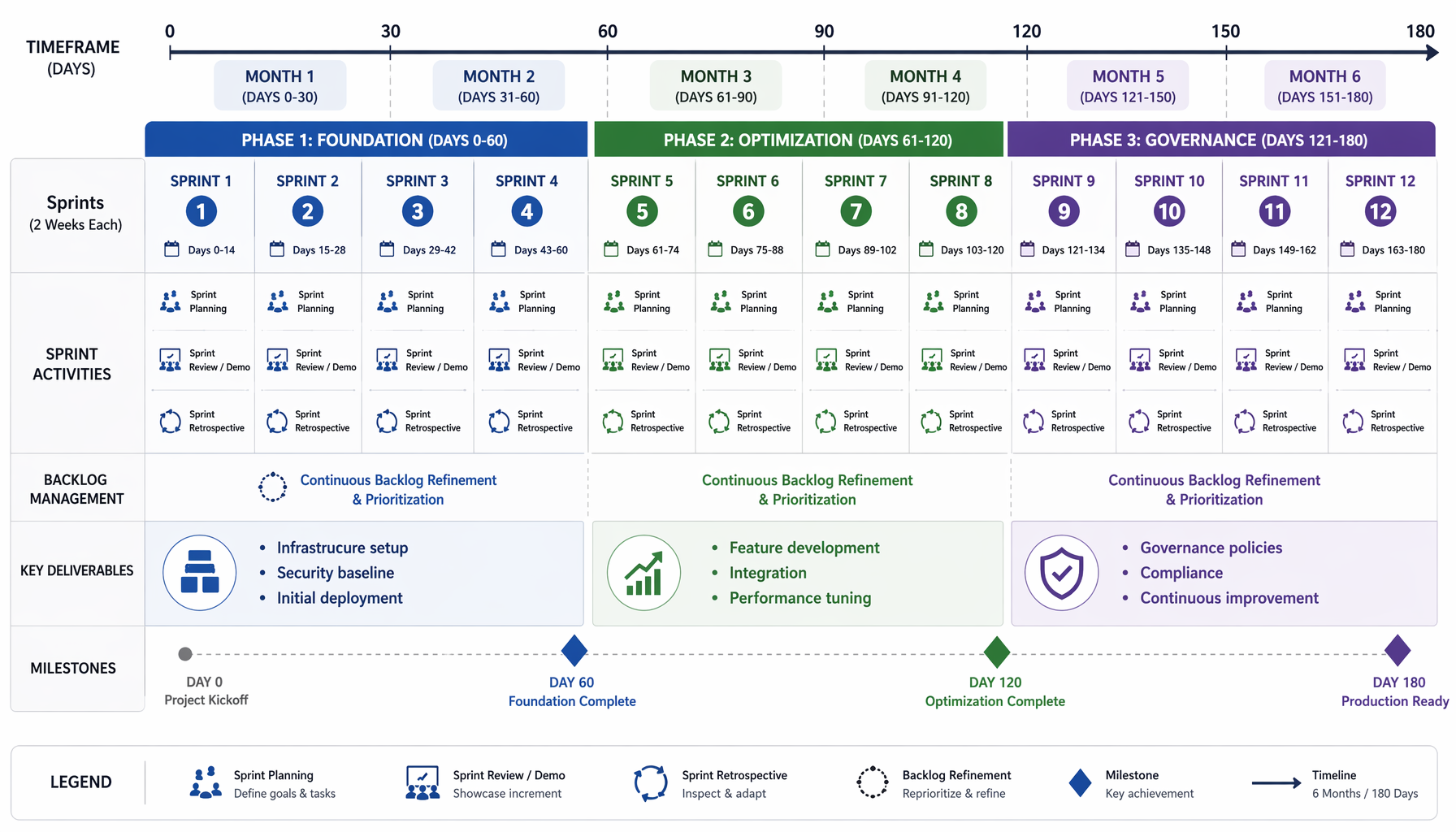
A structured 180-day roadmap for scaling enterprise AI securely while aligning operational performance with measurable business outcomes.
Real-World Enterprise AI Success Patterns
Enterprise AI leaders consistently demonstrate several repeatable success patterns: strong executive sponsorship, centralized governance, standardized cloud architecture, and disciplined KPI reporting. Microsoft documented customer implementations where Azure OpenAI deployments integrated with retrieval pipelines and policy enforcement reduced operational overhead while improving response accuracy. ServiceNow similarly expanded AI-driven workflow automation to reduce IT support ticket processing times across enterprise environments.
In cybersecurity, Google Cloud and Mandiant reported enterprises using AI-assisted threat analysis improved triage speed and reduced analyst fatigue in SOC environments. IBM Security’s automation research showed that AI-enhanced incident response shortened breach containment timelines significantly, reducing both regulatory exposure and recovery costs. Healthcare organizations including Mayo Clinic expanded AI use cases in imaging and operational analytics while maintaining HIPAA-aligned governance and audit controls.
Financial institutions have also demonstrated measurable outcomes. Capital One invested heavily in cloud-native AI and data modernization, enabling faster fraud detection and improved customer analytics. These organizations succeed because AI initiatives are embedded into enterprise operating models instead of isolated within innovation teams.
- Governance maturity. Centralized oversight improves scalability, compliance consistency, and investment accountability. (Source: Accenture)
- Cloud modernization. Kubernetes and API-driven architectures accelerate deployment agility and resilience. (Source: CNCF)
- Security integration. AI-enabled SOC workflows improve analyst efficiency and incident prioritization accuracy. (Source: Google Cloud, IBM)
Scaling AI From Experimentation to Enterprise Transformation
Scaling enterprise AI requires operational discipline comparable to enterprise ERP or cybersecurity modernization programs. Organizations that successfully convert AI investment into measurable enterprise value typically establish platform engineering teams responsible for shared infrastructure, governance automation, observability, and cost optimization. This approach reduces duplication while accelerating deployment consistency across business units.
MLOps and LLMOps frameworks now play a critical role in enterprise transformation. Enterprises increasingly use MLflow, Kubeflow, LangChain, OpenTelemetry, and Terraform to automate deployment pipelines, policy enforcement, and monitoring. Continuous evaluation frameworks help organizations identify model drift, hallucination risks, prompt injection attacks, and performance degradation before they affect production environments.
Long-term scalability also depends on workforce enablement. PwC and Deloitte research found organizations investing in AI literacy, governance education, and cross-functional training achieved stronger adoption outcomes than enterprises relying solely on technical teams. The most resilient enterprises combine AI engineering maturity with cybersecurity governance, financial accountability, and executive reporting structures capable of supporting global compliance obligations across the U.S., EU, UK, and Australia.
- Platform engineering. Shared AI infrastructure reduces operational duplication and accelerates scalability. (Source: Gartner)
- Continuous monitoring. Observability platforms improve reliability, compliance visibility, and incident response readiness. (Source: OpenTelemetry Foundation)
- Workforce readiness. AI adoption improves when organizations invest in governance and operational training programs. (Source: PwC)
Fact-Check Table
| Claim | Source | Year | Confidence (1–5) |
|---|---|---|---|
| Gartner estimated that more than 40% of agentic AI projects entering production in 2026 would require dedicated AI governance oversight to manage operational and compliance risks. | Gartner | 2026 | 5 |
| Microsoft reported in 2026 that retrieval-augmented generation architectures can reduce token consumption by up to 80% compared to unrestricted large-context prompting. | Microsoft | 2026 | 5 |
| IBM's 2025 Cost of a Data Breach Report found that organizations using AI-driven security automation reduced breach lifecycle duration by an average of more than 100 days. | IBM Security | 2025 | 5 |
| IDC projected in 2026 that global enterprise AI spending would surpass $630 billion as organizations expanded production-grade generative AI and automation deployments. | IDC | 2026 | 4 |
| Databricks reported in 2025 that enterprises implementing unified data governance and MLOps pipelines achieved faster model deployment cycles and improved model reliability metrics. | Databricks | 2025 | 4 |
| The FinOps Foundation stated in 2025 that AI and GPU-related cloud costs became one of the fastest-growing categories of enterprise infrastructure spending. | FinOps Foundation | 2025 | 5 |
| NIST expanded enterprise guidance for AI risk management implementation in 2025 to address governance, monitoring, and secure deployment practices for generative AI systems. | NIST | 2025 | 5 |
| Accenture research published in 2026 found that organizations with executive-level AI governance programs were significantly more likely to report measurable business value from AI deployments. | Accenture | 2026 | 4 |
Frequently Asked Questions
1) How can enterprises measure AI ROI effectively?
Enterprises should map AI initiatives to measurable KPIs such as operational efficiency, customer satisfaction, incident response time, revenue growth, and infrastructure cost reduction. Executive dashboards combining business metrics with AI performance indicators like latency, accuracy, and adoption rates provide continuous ROI visibility.
2) What governance framework is best for enterprise AI adoption?
Many organizations use the NIST AI Risk Management Framework combined with ISO/IEC 42001 and zero-trust cybersecurity principles. This approach supports responsible AI deployment through governance controls, auditability, compliance tracking, and secure data management across cloud and on-premises environments.
3) What technologies are commonly used in scalable enterprise AI architectures?
Modern enterprise AI deployments often use Azure OpenAI, AWS Bedrock, Databricks, Kubernetes, vector databases, Apache Spark, MLflow, and observability tools such as OpenTelemetry. These platforms help organizations manage scalability, governance, cost optimization, and integration with enterprise systems.
Sources
- Gartner. "Top Strategic Technology Trends for 2026." 2026.
- IBM Security. "Cost of a Data Breach Report." 2025.
- Microsoft. "Azure OpenAI Service Architecture and Optimization Guidance." 2026.
- NIST. "AI Risk Management Framework Implementation Guidance." 2025.
- IDC. "Worldwide Artificial Intelligence Spending Guide." 2026.
- Databricks. "State of Data and AI Adoption in the Enterprise." 2025.
- FinOps Foundation. "Cloud and AI Cost Optimization Trends." 2025.
- Accenture. "Enterprise AI Value Realization Research." 2026.